
Analysis – The Tool That Makes Smart Minds Even Sharper Than They Already Are
When you analyze, you don’t just break down problems—you build a better brain.

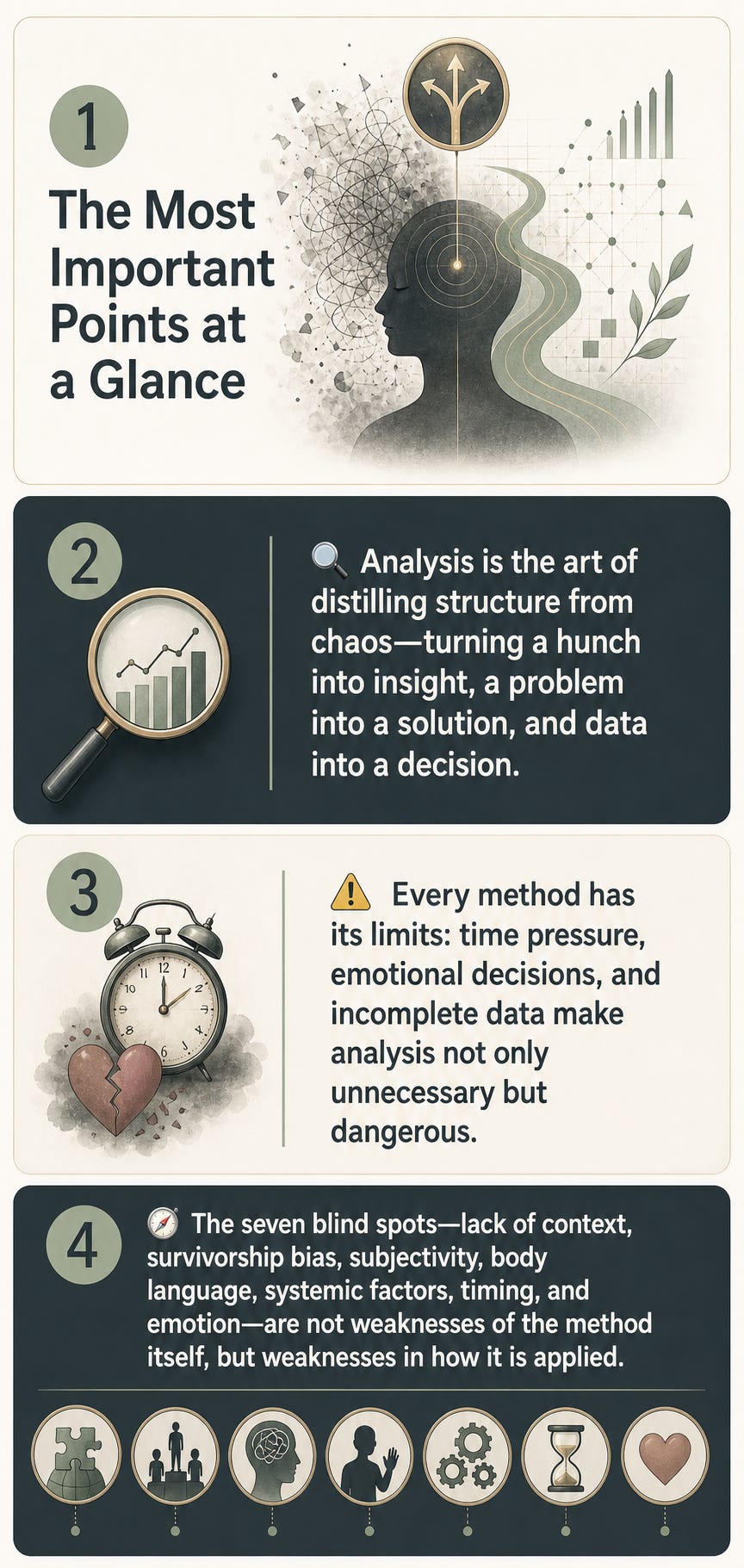
A Look Back at a Week of Analysis
This week was, in a way, an analytical experiment in itself. We examined analysis from every angle: what it is, how it works, where it shines, where it stumbles—and where, with the best of intentions, it turns into an elegant form of self-deception.
The first post explored the essence of the method: analysis as deconstruction, as a tool of thought, as a daily survival strategy for anyone who doesn’t want to simply let things happen around them. The second post focused on its limitations—and thus on the most honest thing one can say about any method. The third shed light on the seven blind spots: those friendly, well-intentioned errors that appear in the guise of analytical rigor and yet usually distract from what is essential.
Anyone who has been following along this week will surely have noticed one thing: analysis is not a skill you acquire once and then check off your list. It is a practice—a daily, iterative, human one.
The Tool Sharpens the Mind—but Only If You Know How to Hold It
“There is nothing to fear in life; one must simply understand everything.”
— Marie Curie
Marie Curie did not analyze to be right. She analyzed because she wanted to understand—even when that understanding cost her her life. What she developed in the laboratories of Paris was not merely chemistry: it was a way of thinking. Hypothesis, observation, decomposition, conclusion, correction. And then all over again. Not because the method was incomplete, but because reality is always one step ahead of the model we construct of it.
Aristotle thought similarly; he declared analysis to be the foundation of all science long before science existed as an institutionalized discipline. And René Descartes—the man to whom we owe the famous phrase “I think, therefore I am”—elevated analysis to the primary duty of the thinker: to break down every problem until one encounters clear and distinct elements.
“Doubt is the origin of wisdom.”
— René Descartes

Leonardo da Vinci’s Vitruvian Man – the Most Beautiful Analysis Protocol in History
Around 1490, Leonardo da Vinci drew his Vitruvian Man—that famous figure with outstretched arms and legs, inscribed within a circle and a square. What looks like a work of art at first glance is in reality an analytical record: Leonardo examined the human body as a system of proportions, ratios, and laws. He broke down the visible into its components, measured, compared, drew conclusions—and in doing so created what is arguably the most famous symbol of the analytical view of life.
For Leonardo, analysis never looked dry or mechanical. For him, it was a form of curiosity—precise enough for science, vivid enough for art.
Sherlock Holmes and the Democratization of Analytical Thinking
“Once you have eliminated the impossible, whatever remains, however improbable, must be the truth.”
Arthur Conan Doyle’s Sherlock Holmes is the most famous analyst in world literature—and at the same time the most convincing proof that analysis is not an academic matter. Holmes observes, asks questions, breaks things down, recognizes patterns, identifies causes, and draws conclusions. Not out of vanity, but because he wants to understand what really happened—beyond the superficial story told by first impressions.
What Conan Doyle embodied in this character is an ideal: trained observation, systematic reasoning, and the willingness to revise one’s own hypothesis when new facts suggest the opposite. This is analysis in its purest form—and it is available to anyone willing to think more slowly than the situation seems to demand.
Analysis Works—if You Apply It Correctly
“Analytical thinking is no substitute for creativity—it is its best servant.”
— Edward de Bono (paraphrased)
Analysis follows a recognizable pattern that runs through all disciplines: observe, ask questions, break down, gather, recognize patterns, identify causes, interpret, draw conclusions. It sounds like a simple sequence—but it isn’t once you’re in the thick of it. As the saying goes, the devil is in the details between steps five and six, where the pattern seems deceptively clear and you stop asking further questions.
The good news: analysis can be practiced. Not with willpower, but with curiosity. Those who get into the habit of pausing, looking closely, and distinguishing build up a kind of internal navigation system over time—one that still works even when the map is missing.
Your Prompt for Practice
Here’s a tool you can use right away—for any situation, any problem, any thought you want to get to the bottom of:
“Help me systematically analyze [situation/problem/topic]. Start with a clear definition of the problem. Then show me the most important sub-aspects, possible causes, existing patterns, and relevant connections. Conclude with concrete recommendations for action. Proceed iteratively: ask me follow-up questions if you need more context.”
Replace the square brackets with your current topic—and let the method do its work.
Main Takeaway
Analysis is not the tool of pedants and perfectionists. It is the quiet, underrated skill of those who prefer to understand rather than react. Those who master it—with their strengths and their blind spots—make better decisions, learn faster from experience, and ultimately communicate their thoughts with greater precision.
That alone would be quite a lot.
Outlook and Challenge
This week’s challenge: Choose a problem or decision from your daily life that’s been on your mind for a while. Apply the eight steps of analysis—in writing, not just in your head. And then: Draw a real conclusion. No further analysis. A decision.
Mental Training Zoom
Focus on: Analyzing
Once a day for seven days: After a conversation, a decision, or an experience, take five minutes—and ask yourself three questions. First: What did I actually observe, not interpret? Second: What pattern do I recognize in this? Third: What would I do differently next time?
No more. No less. But regularly.
Anyone who sticks with this for a week will find that analysis is no longer a method you consciously employ—but rather an attitude you’ve developed. And that, as Leonardo da Vinci would likely have confirmed, is the true purpose of the exercise.